Saturday, November 27, 2010

3 Things I Learned from a Rural Japanese Hospital

Lately, I've been a little too lazy in typing up entries...only because I've been so busy collecting experiences to write about! Recently, I had an extremely informative experience--I went to the local hospital. This is what I learned:

1. Expect to be there for hours.

Back at home, when someone says "I need to go to the hospital," they mean call an ambulance and run all the red lights. Here, instead of going to a normal clinic, a lot of people just head on down to the hospital for their everyday aches, pains, and colds.

When I showed up at the Hekinan City Municipal Hospital, I had to go through the new patient registration, which involved sitting and waiting for the receptionist to make me a plastic patient ID card. Then I made my way down to the internal medicine office, where I was given a number and told to sit around until it showed up on the big screen above the receptionist's desk.

So I sat and waited.

And waited.

And waited.

And waited...for two hours.

Finally, my number flashed on the screen and I was ushered into the hallway that leads to the doctor's office...where I waited some more.

Then I waited for some tests, and then I waited for the results.

All in all, I was there for almost FIVE HOURS.

You would think that after all that, I would never want to go back. Well, you'd be wrong because....


2. Japanese hospitals are really cheap!

Japan is one of the lucky countries that has national health insurance. My insurance pays for 70% of all the costs, leaving me responsible for 30%. And let me tell you, that 30% is miniscule.

For example, three EKGs, a cardio stress test, a Holter Monitor, CT scan, an X-Ray, bloodwork, and ultrasound cost me less than just one of those tests would in the States. Getting an appointment with a specialist to interpret the results cost....$2.50.

I plan on framing that bill!


3. You need to get sick on schedule.

Japanese hospitals have everything and are really cheap, but you better get sick on schedule or you're out of luck. The outpatient clinic at my local hospital is open from 8:30-11:00. That's it.
Should you get sick after hours, you have to find another clinic or risk getting a bigger bill from the emergency room.
Unfortunately, all clinics and hospitals tend to operate in 4 hour blocks, so you might have to drive around or make some phone calls to find one that's running when you need it. 
These 4 block periods of operation are also conveniently scheduled only on weekdays, meaning you have to take time off of work if you want to see a doctor. How convenient!

Saturday, October 2, 2010

Monday, September 27, 2010

Three Reasons Why the Teacher's Room is the Best Place in School

1. The teacher's room is almost as good as Starbucks.

Imagine going to Starbucks...and getting whatever you want for free. Yeah, that's pretty much what the teacher's room is like--a free coffee buffet. There is free coffee all the time, and so many things to stir in it that you can make your own zebra hot chocolate with non-fat milk all by yourself! I don't know if the taxpayers over here are just willing to spring for a few extra levies or what, but coffee and tea seem to constitute a fairly large portion of each school's budget. Each school has it's own tea lady who is paid to make sure the coffee and tea are never in short supply (among other obvs lesser things). In fact, the school I'm at now has a wall-length cabinet housing all of the chinaware the teachers can use.
And use them I do. Who knew coffee, sugar, and dehydrated milk could taste so good? It's so good that I don't even mind shaking in my seat and having to pee every few minutes.
Anything that gives me the stamina to stand up to thee classes of 37 9th graders in a row is worth it!


2. We have a huge, wall-mounted plasma TV.

When my Dad bought a huge TV for our house, my sister and I joked that he must be going through a mid-life crisis, because no one actually needs a TV that big. No, Daniel, not even you need a TV that big to play video games on.

Well, I take back everything everything I said in disparagement of that TV now. The teacher's room has the biggest, shiniest, most beautiful TV. It is my shining beacon of hope when I struggle back, disheveled, from my overwhelmingly rowdy third year class, or when I arrive at school after biking through torrential rain. Yes, that TV is the smbol of relaxation and well-being.

Of course, I can't actually see it from my desk, which is so far in the corner that it's almost in the hallway, and it appears to only project satellite images of Japan's current weather, but its mere presence is enough.


3. It is a shelter from the storm.

So, middle schoolers are kind of loud.

I shout myself hoarse to be heard in class, and have occasionally been known to send stern looks at particularly naughty students...or, you know, just happen to call on them for the hardest question that I actually may have made up on the spot just for them.

In the hallways, I am chased by hordes of students screaming "Lindsay Senseeeeeeei!!!!1!1" and creepily stroking my hair from behind, who all desperately need to know whether or not I have a boyfriend or if I think a certain actor is cute. Hint: If his hair is as long as mine and has obviously been in rollers half the day, there is no way he can be considered either masculine or attractive.

As much as I appreciate being told how beautiful I am at every corner (which may have something to do with me promising As to those thoughtful students who compliment me so), I like it somewhat less when it's being screamed into my right ear.

Which has coincidentally been popped for most of the day...thanks, Ayaka. :(

The teacher's room is my respite from these wild and crazy kids, where I can sip my coffee, sugar, and reconstituted milk in peace. Yum!

Saturday, September 25, 2010

One Thing I Learned from a Sports Festival

1. Sports festivals are serious business.

Sports festivals are sports competitions held in schools all over the nation around this time of year. The school is divided into teams, and on a Saturday in September these teams battle it out during sports events to rack up points and hopefully win a trophy and bragging rights. The events include relay races, 100m dashes, tug-of-war, and some uniquely Japanese games. But sports festival is not like the Field Day you remember from elementary school. Oh no, sports festivals in Japan are Serious Business.

Here are a few pictures and videos from the opening ceremony. Yes, the opening ceremony. Like the Olympics.

A few select students carry the school flag and the Japanese flag to raise over the field. 


The students process in and circle the field, team by team, marching like little soldiers while Fanfare plays.They are lead by the piercing whistles of one of the teachers straight into a microphone...ow.


Next, each of the teams, Red, Blue, and Yellow, approach the stands, where the teachers and spectators are waiting. They stand through endless speeches by various students and faculty, and then sing the national anthem and the school song. Don't worry--I won't make you listen to 325 kids singing.


Notice that each team has their own flag--a student from each team designed it.


After the speeches are finally over, all of the students stretched.


It was like watching a movie, everything was so perfectly executed. What happened to the rowdy kids from English class, or the one who fell asleep in the third row??

The coveted prizes are three trophies: one for the team that scores the most points (the huge one that's half my height), one for the team with the best group cheer and general supportive spirit (the plaque), and one for...well, I'm not really sure what that last one is for. 
 
 The games included a few that I had never seen before, like bohiki. This game is kind of like tug-of-war. Two teams rush at a bunch of poles on the ground, and attempt to drag it back across the line of their boundary.
 They have to out-pull the members of the other team who are going after the same pole. When they realized they were losing a stick, the girls often gave up and ran to another stick to try and help their teammates pull that one back. 

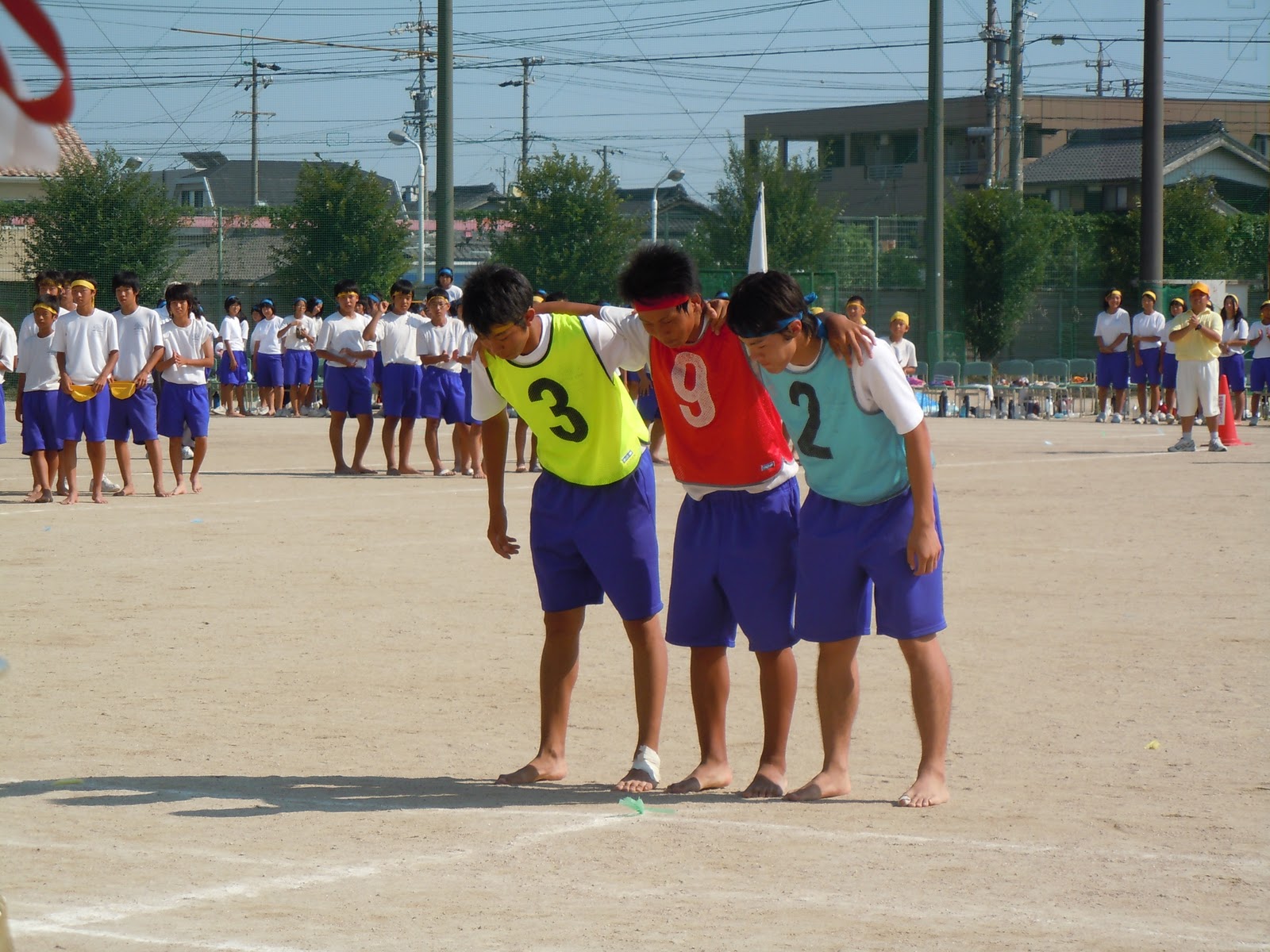
The most interesting game by far was called kibasen. The boys made groups of three who hoist a fourth on their shoulders. It looks like this:


 Then, with the fourth hoisted up in the air, the three boys on bottom run around trying to position the top guy to snatch the cap off a guy from the opposite team. 


One boy on each team wears a jersey, like this:
 He is the king, and when his cap is pulled off, the game is over.


During the practice round the day before the actual Sports Festival, the red team was crushed every time. They clearly did some thinking overnight, because when they got to the real game, all of their players crowded around the king and refused to move. The other team had to try and rush them, and the reds could just pick off the other team one by one. 

After each game, representatives of each team thank the crowd. 

 
 The whole time, the score was kept like this:


Finally, the prizes were awarded. The red team, which incidentally had the coolest flag, won the overall, and the yellow team won the cheering and mystery prize.
 

Apparently I didn't appreciate just how big a deal this festival was, because I was surprised when the representatives of each team CRIED when receiving their prizes. Even the boys, who are in the throes of middle school insecurity, were bawling like babies!

I guess I'm lucky to have witnessed such an important event, even if it was unknowingly!

Monday, September 13, 2010

Three Things I Learned Today


1. School lunches are...interesting.

Remember school lunches when you were back in Middle School, when everyone swore that the cheese was so plastic it bounced, and nobody was sure what kind of meat they were eating under a smear of gray sauce?

Well, I guess I can't really hide under the banner of living through those awful lunches, since my middle school lunches were professionally catered (ah, the perks of Catholic school). Unfortunately, the universe wasn't content to leave it at that, so I am now accumulating all of those lunchtime experiences I should have had years ago. 

The school lunches here aren't bad--they're just weird. Take today's lunch for example. Alongside a  massive pile of soybeans and some kind of Indian-spiced chicken was cabbage and carrot soup....with hot dogs.

Yes, hot dogs. There were cut up hot dog pieces floating amidst my vegetables. 

I'm not sure what Japan's fascination with hot dogs is, but this is the third time they've shown up my school lunch, and it's only the 7th time I've eaten them.

The other usual suspect is carrot. Carrots are in every lunch every day, without fail. Apparently it's a special crop in the area. The other day, it appeared in my pineapple salad (pineapple and carrots are actually pretty good together).

School lunches are very different here, mainly because the schools don't have cafeterias. Everybody eats in their classrooms, and representatives from every class dress in white smocks and hairnets to bring the food up to each room and serve it to their classmates. It's a nice way to keep the lunch time madness down, but it must suck if your good friends aren't in your homeroom.

2. The buses in Hekinan are free.

THE BUSES IN HEKINAN ARE FREE.

It costs absolutely nothing to ride them! And, even better, if the bus is too full to let you on, they'll pay for a taxi to take you to your destination! 

I think the importance of this lesson is self-evident.


3. My water got cut off today. 

Today I came home to find my water had been cut off. 

I attempted to wash my hands, only for the water to disappear halfway through. A quick check around the apartment told me that nothing was working, not even my shower (and in this weather, that is not a good thing). 

My head is filled with worries about my water bill--did the direct deposit not work? Did I somehow miss a start-up fee?

I went over to my neighbor's, only to find that she had the same problem. I called my supervisor at City Hall, who consulted with the Water Department, then my landlord, and nobody knew what was going on.

Finally, just as suddenly as it disappeared, the water came back. Nobody knows what happened.

A case for Unsolved Mysteries.


On the weather front, today stayed under 90! :D

Saturday, September 11, 2010

Four Things I Learned from a Japanese Middle School

Weather update: At 10:30 at night, it is a comfortable 83 degrees, and may get down to the low 80s in the daytime on Sunday! Has Hades been vanquished? 

1. Japanese schools kind of look like jails. 

Take Chuo Middle School, for example: 


Drab, concrete building suggests joy-sucking properties. Notice the gate surrounding the building, cutting off avenues of escape, as well as it being set apart from other buildings. All that's missing is a "no hitchhiking" sign. 

Despite the external similarity to a detention center, the inside of the schools is a very lively place. Central to the school I worked in the past few weeks was one of three air conditioned havens, the teacher's room. We even have a tea lady, who serves us mugicha! 

Now, if you are nerdy enough to have seen Battlestar Galactica, you might think that this middle school looks Cylon-esque:


Not like I would know or anything. 

2. Having a schedule doesn't mean it's right.


The first day of school, I was sitting in the teacher's lounge, when I suddenly noticed that nearly everyone had disappeared. Where had they gone? Was I supposed to go, too? I consulted with my handy schedule only to find that the entire day was completely blank. 


Great.


I decided to sit there for a while and see if any teachers came back, or perhaps follow the next teacher to leave. After a few minutes, one teacher managed to escape out an exit previously unknown to me, leaving me alone with the school secretary. 

"Um," I said awkwardly. "Is something going to start soon?" 


"Yes, the school assembly starts in a few minutes," she answered.


The school assembly...where I was supposed to be introducing myself to the entire student body. Good thing I was told about when it would be in advance, right?


Instead of going over my short speech in my head, I spent the minutes leading up to it racing through a few hallways, trying to figure out where the gym was. 


Apparently, there are some things that have to be learned by osmosis here. Not everything is spelled out for the benefit of the new foreign teacher, for better or for worse. That leaves me with the option of just following people like a stalker or asking incessant questions. At the risk of being clingy and annoying, so far I've chosen the latter.


3. Teaching children who don't speak English without uttering a word of Japanese is really difficult.


Before my first day, I went up to Nishibata Middle School with my city hall supervisor to be introduced to the principal. The principal is a very nice man who fits the stereotype of the absent-minded professor. Along with some conversation, he repeated several times that he was looking forward to me only using English in the classroom, but being able to use Japanese with the teachers when I am safely hidden away in the teacher's room. 


I took the hint to mean no using Japanese in the classroom. No problem, I thought. I'll speak simply.


Unfortunately, I could repeat "Please be partners. Please answer the questions. Then, please introduce your partner" until I was blue in the face, but it wouldn't make my requests any clearer to my poor students. 


Using a little Japanese tends to make things go a little more smoothly, especially when sandwiched by English, so they can (hopefully) pick up a few new words. It's a lot easier to get things done when the kids understand what they're supposed to do!

Plus, the students feel more relaxed to know that we can actually communicate pretty well, even if they can't speak English, which helps in cases like Alfred's....


4. Some children are absolutely terrified of speaking to foreigners...even in Japanese. 

This last lesson I learned during one-on-one conversations with students. They were tasked with memorizing a conversation to practice with me (What's your name, welcome to Hekinan, what's your favorite color, etc), and then answering three questions I posed. One-on-one conversations were more difficult for some students than others, especially students like "Alfred." 


Alfred is a very cute 8th grader with the Japanese equivalent of a fro. He's the kid spouting snide remarks from the last row that you can't help but laugh at, even when you're the butt of the joke.  


Put him in front of me, though, and he can barely string a sentence together. 


Poor Alfred approached my desk with the enthusiasm usually only reserved for death row. Even after helpfully angling my script so that he could read it and reassuring him several times that he would be fine, he looked as if he would keel over at any moment. The kid couldn't even look at me.


"Poor guy has test anxiety," I thought, and went easy on him.

The next day, it was my turn to eat lunch in 2C (there's no cafeteria--students eat in their classrooms, and teachers join them). Guess who sat next to me? Alfred, of course! "Now we can talk in Japanese, and he'll feel a little better," I thought. 


Wrong. 


Poor Alfred nearly fainted when he saw that I was sitting next to him. He tried to get the everyday teacher to put me somewhere else without success, and was teased mercilessly by his classmates that he would have to speak in English the whole time. I tried to joke around with him a little and managed a few responses...until he turned his chair around and refused to even look at me for the entire rest of the period.

Thank God they didn't put me next to the girl who cried.